Life is busy sometimes, and it means I've been ignoring the food blog... which isn't to say that I haven't been eating.
Chick pea burgers remain a staple in the home, but I've evolved the recipe.
Ingredient list:
-1 egg
-1/2 yellow onion
-2 tbsp flour
-1/2 tsp chili powder
-1/2 tsp ground cumin
-1/4 tsp salt
-1/2 can chick peas
-1/2 can black beans
-extra light olive oil
-1/2 cup greek yogurt
-1 tbsp tahini
-juice from 1/2 lemon
-1/4 cup thinly sliced celery heart
-sliced beefsteak tomato
-4 whole grain half-pita pockets
Pre-heat a cast iron skillet to just higher than medium heat. Use enough olive oil to coat the entire bottom of the pan.
Throw the egg, flour, salt, spices, and onion into the food processor. Mix until it's a gooey paste. Then dump in the chick peas and black beans and pulse a few times to get a coarse mixture. Mixture should make four patties. Fry in the oil for a few minutes on each side. Thanks to the onion, the patties may start to look almost black. Trust me, they're fine... they actually taste a little better that way. Crispy fried onions and chick peas are wonderful.
While the patties are frying, mix the yogurt, tahini, celery heart, and lemon juice in a bowl to make the sauce for the patties. Lately I've been using the very core of the celery heart for this... it's thin enough and the celery flavor isn't quite as strong, and it's the part of the celery bunch that I never really know what to do with anyway.
Serve in pita with a slice of tomato, and the yogurt sauce. Lately we've been buying the pita from Costco... it's a little smaller, so there's less leftover bread... and, it's cheaper.
Half a can of beans, half an onion, etc... I don't really leave half of two different cans of beans and half an onion typically, I do a second batch to provide lunch for the next day. I usually let it fry while we eat the first batch.
Showing posts with label cast iron skillet. Show all posts
Showing posts with label cast iron skillet. Show all posts
Tuesday, March 15, 2011

Saturday, January 15, 2011
Date Night! Red pepper and Goat Cheese Frittata

So, I'd never made a frittata before. I'm going to be making more of them, though. Score one more for the cast iron skillet.

-1 Cup sliced up red bell peppers
-1 bunch of scallions, chopped
-8 Eggs
-1/2 Tsp salt
-1/2 Tsp finely chopped Oregano
-1/2 Tsp freshly ground pepper
-1 Tsp Extra Light Olive Oil
-1 Cup crumbled Goat Cheese
-1/2 Cup Robust Gouda
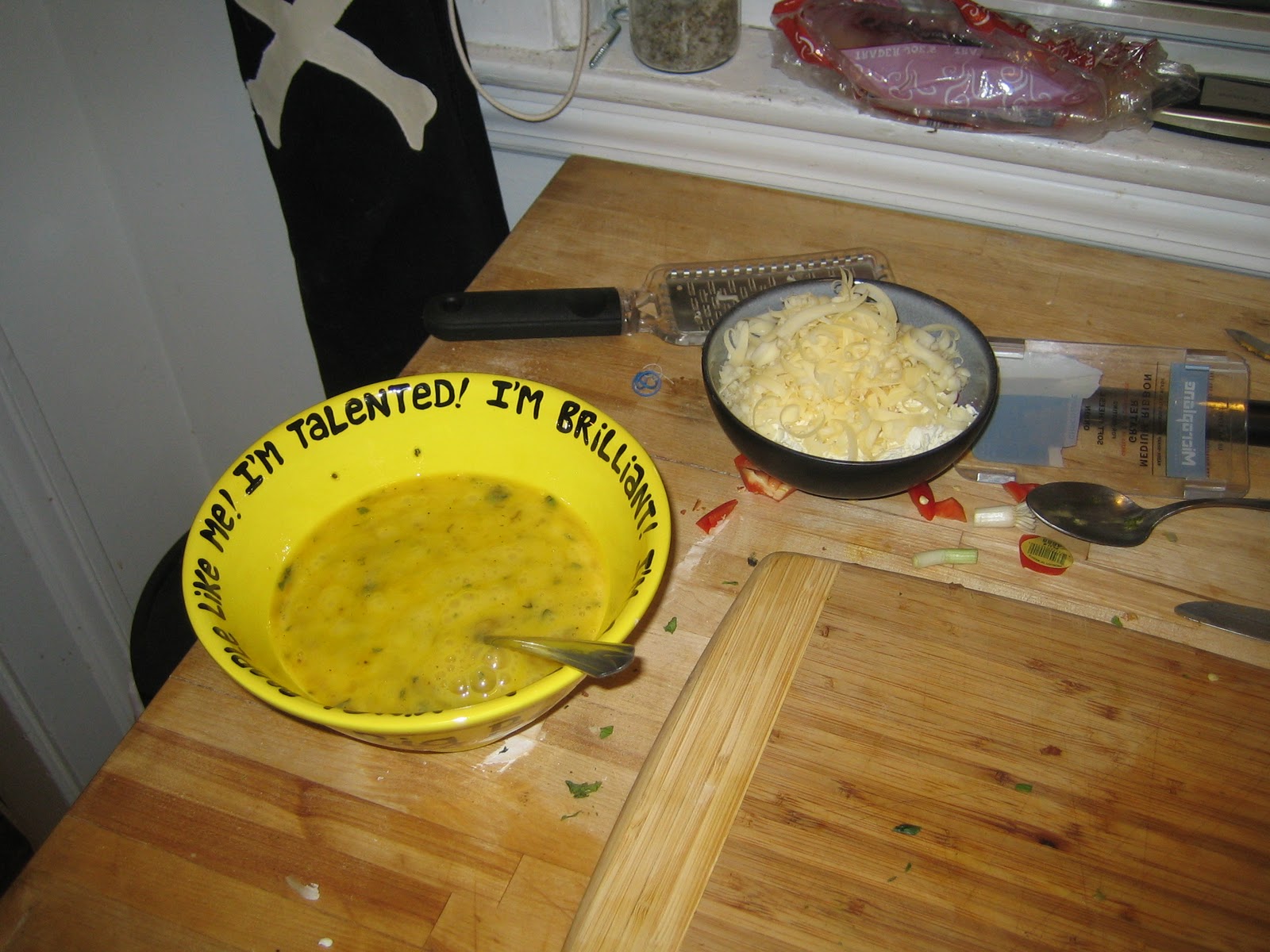
Pre-heat the Cast iron Skillet to the high side of medium. Turn on the broiler and let that go for a while. Put the rack close to the top of the oven.
Mix up the salt, pepper, oregano, and eggs.
Put in the oil. Put in the vegetables. Fry the veggies until they're starting to feel cooked. (3-4 minutes)

Pull the skillet back out, and let it cool for 3-4 minutes more. The skillet will continue to lightly cook the eggs, so the finished product is moist, but not wet or runny. After it's cooled a bit, and has started to pull away from the pan, flip the whole thing over onto a platter or dish that's large enough.
The finished product is a thing of beauty, but I really wanted to have one more part to the meal, so I baked some sweet potato fries to serve with the frittata.
Yum.
Friday, December 10, 2010
German apple pancake

This is a great recipe that I found a month or so ago. I've made it a few times, and served it up to a bunch of folks at a brunch that we had at our house a few weeks ago. Among other things, we also served up some thinly sliced kielbasa that we'd fried up in a pan on the stove. Somehow, someone discovered that the two things pair up very well... a great combination of sweet and savory.
The version you see in the photos is a scaled down version for one person, made in a 6" skillet. But the recipe itself, and the portions I'm going to list, are for a 12" skillet.
Ingredient list:
-1/4 stick of butter for the frying pan
-1/4 stick of butter, chopped up, to go into the food processor.
-2-3 apples, cored and cut into small pieces. Use granny smith, or something else that's nice and tart.
-1/2 cup milk
-1/2 cup flour
-4 eggs
-3 tbsp brown sugar to go into the food processor
-1 tsp vanilla
 -1/4 tsp salt
-3 tbsp brown sugar to be sprinkled on the apples
-1/4 tsp ground cinnamon to be sprinkled on the apples
Step one: Pre-heat the oven and the skillet. Turn the oven up to 450, and get hte skillet warmed up to medium-low.

 Step two: Saute the apples in butter. This is pretty simple, really. Butter in pan, apples in butter.
Step three: While the apples are frying up, put the butter, eggs, milk, flour, salt, and vanilla into the food processor to make the batter. (Or mix by hand, your option, but the food processor means I don't have to soften or melt the butter.)
Step four: Once the apples are starting to brown, sprinkle them with brown sugar and cinnamon. Then pour the batter over the apples and move the whole pan into the oven.
Bake at 450 for 12-15 minutes. Serve with powdered sugar, or maple syrup.
Enjoy.
Thursday, November 11, 2010
Primer for cast iron skillets (and other cast iron cookware)
We got a cast iron skillet as a wedding present. There was a short learning curve about proper care and handling, but I'm wishing now that I'd looked into cast iron sooner.
Thankfully, Paul also referenced a blog entry by Sheryl Canter, on the chemistry of seasoning cast iron. Paul mentions that a lot of Sheryl's science is over his head. Some of it's over mine, too. But even though I haven't read up on the formation of polymers, she thoroughly spells out her logic and process, and details her results. Her explanation of her choice of oil to use when seasoning a pan made a lot of sense to me. And the photos of her seasoned pans convinced me that her scientific approach was far superior to the dogmatic, my-grandpa-said, "it's always done this way" approach of some of the other sources I found online. Sheryl's use of flax seed oil (Food-quality linseed oil, sold as an Omega-3 supplement), solved the kosher/vegetarian issue for me. And as a nice counterpoint to Paul's methods, Sheryl makes a good, if scary point about cooking with bacon grease:
"Since lard is traditional but no longer readily available, many people substitute bacon drippings, but this is a bad idea. If it’s conventional bacon, you’re baking in carcinogenic nitrates. But even organic bacon is not good for an initial seasoning because it’s filled with salt."
It's worth the time to go read the pages I mentioned above. Paul's for day to day use, and Sheryl's for seasoning and restoration. But these are what I consider to be the high points for restoring cast iron cookware:
-When stripping vintage cast iron cookware, use oven cleaner that contains lye, and bag the thing up while the lye goes to work. 24 hours later, put gloves on, take the pan out, and scrub off all of the black that you can. Repeat this process until the whole pan is down to bare, gray iron. Some of the professional resellers simply keep a lye bath in a plastic tub in their garage, and soak the pans for a few days. I'm not that fanatical or dedicated.
-Pre-heat the skillet before adding ANY oil. If there is any water left in the pores of the skillet (and cast iron is very porous) the oil will not adhere. Once the pan is hotter than the boiling point of water, it will be absolutely bone dry. Since I'm already going to be seasoning the pan in the oven, I simply put the pan in while the oven is pre-heating.
-Season with flax seed oil. Heat the oven to 450-500 degrees. (whatever your max temp is) Wipe a very thin coat of oil on the pan, and then wipe off as much oil as possible. Then put the pan in the oven to basically burn the oil onto the pan. I left the skillet in the 500 degree oven for an hour, and then left it in there to cool after I turned the oven off.
---My experiences so far---

After several failed attempts, and after reading Sheryl's blog entry, I decided to strip the whole thing down and start from scratch. I sprayed the pan down with oven cleaner and put it in a plastic bag. 24 hours later, I scrubbed it down, and decided it needed another round, so I sprayed it down again, with a heavier coat, bagged it up, and left it.


---
Update, 11/15/10
I realized a few weeks ago that smaller skillets don't seem proportioned for full-on cooking jobs. My reasoning... there's really not much room to move a skillet around in there. Rather, they seem proportioned for cooking up a single serving of a particular recipe, such as the German Apple Pancake recipe I discovered recently. So, my logic being what it is, this seemed like a good reason to pick up a second #3 sized skillet... so I could cook for two. This time I got an even older Griswold.
One of the things I'd read while I was down in the rabbit hole was that older skillets had a much better surface finish, and that the older Griswolds were superior in this regard. This seems to be true. Not only is the surface cleanly machined, but it lacks the concentric machining circles that are visible in the skillet above. Instead, it looks nicely sanded. And while the pan definitely needs to be reseasoned (it's in the oven now) it was glossy enough in spots when I got it that I have high hopes for this little skillet.
More later, this entry is long enough as it is.
Tuesday, September 21, 2010
Buying cast iron
When I'm interested in learning about something new, that I'm interested in buying, I go on an eBay safari. Most recently, I was looking at cast iron skillets, but this is an exercise that could be carried out on almost anything. (cast iron, copper, knives, etc.)
Using the generic search words 'cast iron skillet,' I started learning about brands I never heard of. The Erie company later became Griswold, which was eventually absorbed by Wagner. A trip to Google taught me that there are whole online groups devoted to collecting Griswold cast iron, and they have online knowledge bases.
Forget your typical 3 bears (Small, Just-Right, and Large) sizes. I found skillets in numbered sizes ranging from 2 to 14. A number 3 skillet is 6 1/2" across. A number 14 is over 15 inches in diameter. ("Big enough to cook a full dozen eggs!") And in the 'also available from this seller' sections, I found skillet, griddles, dutch ovens, oval roasting pans, chef's skillets, deep skillets, skillets that doubled as lids, waffle irons, (actual iron waffle irons!), flop griddles*, and a whole lot more... and almost all in numbered sizes.
eBay can be like craigslist sometimes... people selling junk for anything they can get for it. But over the years, a class of professional eBay vendors has also arisen, and the variety of quality and restored vintage goods can be astounding. In the case of cast iron cookware, I found a number of vendors who strip, scrub and re-season the pans before selling them, with good reason: A good looking pan sells better, and it's less work for the buyer. But not only that, a lot of the older items just have more character than new stuff. I've found things on eBay that I didn't even know existed... and things that I can really appreciate the usefulness of. In other words, eBay is a way to shop not just for what's new, but to browse a selection of almost everything that has ever been made.
Some of the pans I found were well over 100 years old. They looked great. Compared with some of the 30 year old enameled cookware, they looked brand new. I wonder where these pans have been, and who they made breakfast for. I respect anything that was made well enough to last for 100 years, and still be in a good, functional condition.
 Old iron is affordable. I paid $8.95 for a Griswold #3 skillet, plus shipping. And while the prices for some of the other things, like the oval roasters, was in the 200-300 dollar range, it's still much less than you'd pay for a new one at a niche store... and that's only if you could find it.
-----------------
*Flop griddle: This was a new one to me. This is a 2-part, articulated griddle for making pancakes. The pancake is poured in one side, and then 'flopped' over to the other side of the griddle to have the other side cooked.
Using the generic search words 'cast iron skillet,' I started learning about brands I never heard of. The Erie company later became Griswold, which was eventually absorbed by Wagner. A trip to Google taught me that there are whole online groups devoted to collecting Griswold cast iron, and they have online knowledge bases.
Forget your typical 3 bears (Small, Just-Right, and Large) sizes. I found skillets in numbered sizes ranging from 2 to 14. A number 3 skillet is 6 1/2" across. A number 14 is over 15 inches in diameter. ("Big enough to cook a full dozen eggs!") And in the 'also available from this seller' sections, I found skillet, griddles, dutch ovens, oval roasting pans, chef's skillets, deep skillets, skillets that doubled as lids, waffle irons, (actual iron waffle irons!), flop griddles*, and a whole lot more... and almost all in numbered sizes.
eBay can be like craigslist sometimes... people selling junk for anything they can get for it. But over the years, a class of professional eBay vendors has also arisen, and the variety of quality and restored vintage goods can be astounding. In the case of cast iron cookware, I found a number of vendors who strip, scrub and re-season the pans before selling them, with good reason: A good looking pan sells better, and it's less work for the buyer. But not only that, a lot of the older items just have more character than new stuff. I've found things on eBay that I didn't even know existed... and things that I can really appreciate the usefulness of. In other words, eBay is a way to shop not just for what's new, but to browse a selection of almost everything that has ever been made.
Some of the pans I found were well over 100 years old. They looked great. Compared with some of the 30 year old enameled cookware, they looked brand new. I wonder where these pans have been, and who they made breakfast for. I respect anything that was made well enough to last for 100 years, and still be in a good, functional condition.

-----------------
*Flop griddle: This was a new one to me. This is a 2-part, articulated griddle for making pancakes. The pancake is poured in one side, and then 'flopped' over to the other side of the griddle to have the other side cooked.
Subscribe to:
Comments (Atom)